

As of January 1, 2027, all meters must be remotely read. This idea is circulating, even on specialized websites. However, it is only half true: the deadline does exist for heating and hot water, but no regulation requires remote reading of cold water meters. This confusion has real consequences, as the preparation for a campaign differs greatly depending on the device involved.
Here is what the regulations actually state, who must act, and what the deadline changes for the teams intervening in residential units.
What the January 1, 2027 deadline really means
The devices concerned
The requirement targets the individualization of heating, cooling, and hot water costs in collective buildings. According to article R174-2 of the French Construction and Housing Code, a collective residential building equipped with a central heating installation, or supplied by a district heating network, must be fitted with individual thermal energy meters. The same logic applies to cooling. When these meters are technically impossible or too expensive to install, article R174-4 provides for the use of heat cost allocators instead.
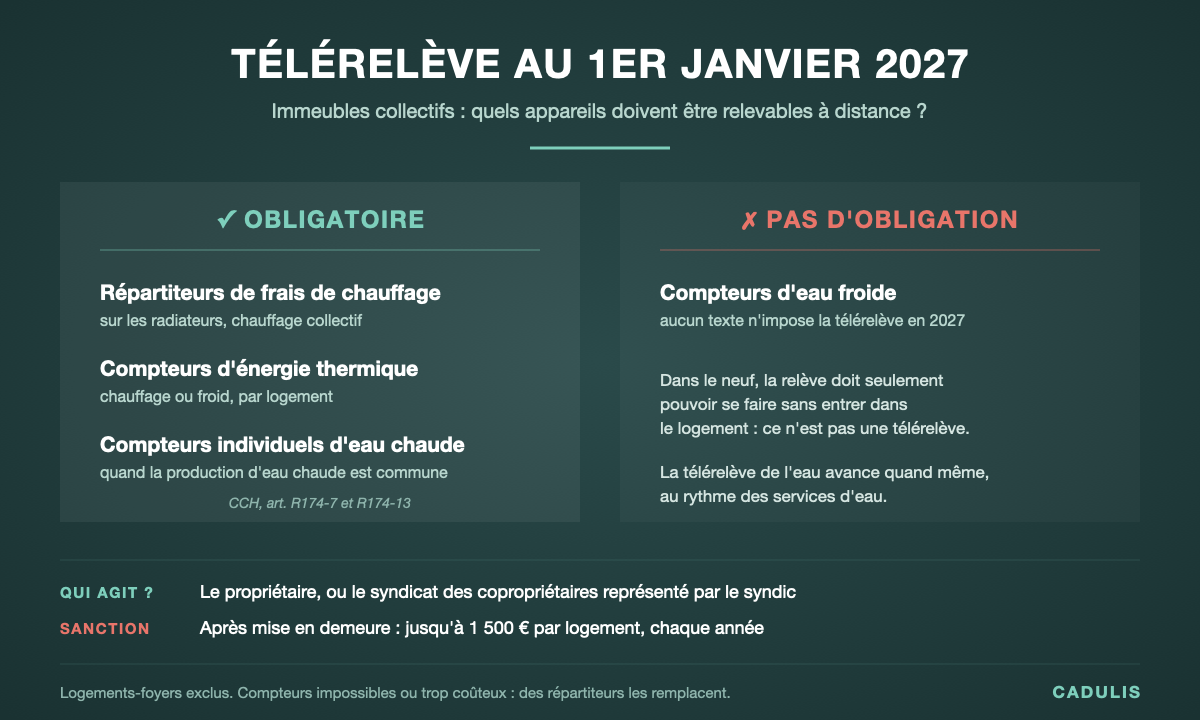
Article R174-7 then sets the timeline: devices installed since October 25, 2020, must already be remotely readable, and “as of January 1, 2027, all devices must be remotely readable.” Article R174-13 applies the same deadline to individual hot water meters in buildings with shared hot water production. The Ministry for the Ecological Transition explicitly includes heat cost allocators in this deadline.
Three types of devices are therefore concerned: thermal energy meters, heat cost allocators, and domestic hot water meters.
Exemptions, in two stages
Not all collective buildings follow the same path. Only residential homes are immediately excluded. For others, exemptions work in stages: when thermal energy meters are technically impossible, too costly, or when consumption remains below a threshold set by decree, the code does not exempt from everything, but requires heat cost allocators instead. Only a new technical impossibility, a new excessive cost, or a specific threshold for allocators grants a further exemption, and the owner or association must justify this in writing. Hot water follows its own set of exemptions, outlined in articles R174-16 and R174-17.
In the event of an inspection, the owner or association must be able to provide the reasons justifying an exemption, as required by article L185-2.
Where the date comes from
The date comes from European law. Directive (EU) 2018/2002 on energy efficiency requires that meters and heat cost allocators already installed become remotely readable, or be replaced, by January 1, 2027 at the latest, unless the Member State demonstrates that it is not cost-effective. France transposed this in 2020, and the 2023 directive that succeeded it kept this deadline. At the time of writing, no postponement has been published: the relevant articles remain unchanged on Légifrance.
What remote reading changes for occupants
Remote reading also serves to inform occupants. When devices are remotely readable, article R174-12 provides that the evaluation of each unit’s heat and cooling consumption must be sent to them every month, since January 1, 2022. Article R174-14 extends this information to domestic hot water. Once all devices are remotely readable, this monthly information should therefore apply to most equipped buildings.
Remote reading of cold water is not mandatory in 2027
No regulation requires it
We searched for a requirement for remote reading of cold water in the construction code, the energy code, and European directives. We found none.
For new constructions, the code requires cold water measurement per unit, readable without entering the occupant’s home. This requirement does not mean remote reading, nor does it set a deadline. As for the 2003 decree on the individualization of water supply contracts in collective buildings, it does not mention remote reading at all.
Where the confusion probably comes from
The energy code does contain an article making all metering systems “remotely readable” by January 1, 2027 at the latest. However, this text appears in the section dedicated to heating and cooling networks, and targets the delivery point supplying the building. It does not concern residential devices or cold water. When combined with the two articles from the construction code, it is enough to generate the circulating idea.
Remote reading of water is still progressing
Remote reading of water is nevertheless advancing, by service choice rather than by regulation. The Montpellier Méditerranée Métropole Water Authority thus launched in 2025 the deployment of remote reading for 86,000 subscribers, with completion scheduled for 2027 and costs covered by the Authority. Orléans Métropole is also deploying it, with free installation and a prior letter proposing a date and time slot.
These deployments face the same challenge as any campaign at the user’s premises: access to the meter. In Montpellier, when the meter is on private property and the subscriber is absent, teams leave a flyer with a number to schedule an appointment. In Orléans, the subscriber’s presence is only required if the meter is on private property.
A remote water reading campaign therefore follows the schedule of the service commissioning it, not a legal deadline.
Who is responsible for compliance, and what it costs if ignored
For heating, cooling, and hot water, responsibility is clearly assigned. According to article L174-2, the building owner or, in the case of co-ownership, the association of co-owners represented by the property manager, must ensure the building is equipped with the required installations.
Compliance is then monitored through a three-step procedure, described in articles L185-1 to L185-4:
- authorized agents may request documents proving compliance, to be provided within one month;
- in case of non-compliance, the administrative authority gives the owner or association formal notice to comply;
- if there is no response or compliance, it may impose an annual penalty per building, up to €1,500 per unit, until compliance is achieved.
What the deadline changes in the field
Devices to be replaced, often in the occupant’s home
Devices that are not yet remotely readable must become so or be replaced. However, a heat cost allocator is installed on each radiator: replacing it requires entering the dwelling, room by room. This brings back all the challenges of a campaign conducted in the presence of the occupant.
Landlords who are replacing their allocators are already facing this issue. For example, a public housing office in the Vosges announced the intervention day by posting notices in the buildings, asking absent tenants to entrust their keys to an adult who will be present on the day of the visit.
Summoning without multiplying visits
The closer the deadline gets, the more expensive each missed visit becomes, as there is less time to return. Organizing such a campaign is very similar to that of replacing water meters:
- group the dwellings by building to chain interventions together;
- invite occupants by email or SMS, with a link to confirm or reschedule their slot;
- follow up in stages with those who do not respond, up to sending a letter;
- record the reason for a failed visit on site, so the case can be rescheduled;
- keep proof of the visit, with a photo of the closed door and GPS coordinates as evidence.
The pace is also important. In a building, neighboring dwellings are handled on the same day; each absence therefore means a new visit to a building the team has just left.
With Cadulis, these steps are managed in a single tool, from scheduling to the technician's report. The user chooses their appointment from time slots that fit the route; we described this principle in our article where your clients book appointments directly on the technicians' schedule.
What Cadulis does not do
Cadulis organizes interventions: appointments, routes, technician visits, and report submission. However, it does not provide measuring devices, remote reading systems, or the allocation of charges between dwellings. These roles belong to manufacturers, metering companies, and building managers.
Remote reading of water and heating: key takeaways
The January 1, 2027 deadline is very real for heat cost allocators, thermal energy meters, and hot water meters in collective buildings. It does not apply to cold water meters, for which remote reading progresses at the pace of water services.
To learn more about meter reading, see our technological innovations for efficient meter readings.
Are you preparing to replace devices before the deadline? Send us the number of dwellings and the area concerned: we will show you how to pre-schedule your visits, with no integration or commitment required.