The technician rings on the third floor. The meter is behind the door, in the entrance closet, and no one answers. He slides a notice of passage under the door, goes back down, and the appointment needs to be rescheduled. In a water meter replacement campaign, installation is quick; a repeat visit, however, means another trip.
Here’s what is prepared before the campaign, what happens during user notification, and what occurs on the day the door remains closed.
Why Water Meter Replacement Depends on Absentees
Where Campaigns Come From
According to regulations, a cold water meter in service does not last indefinitely without inspection. The decree of March 6, 2007 requires periodic verification, meter by meter or by statistical method on batches. The validity of the first periodic verification is 9, 12, or 15 years depending on the meter class; subsequent checks are every seven years. For a batch, the deadline is the soonest among its meters.
Contrary to popular belief, the regulation does not require replacing a meter at a specific age. Faced with these deadlines or the age of the fleet, a service may nonetheless prefer to renew entire batches. These campaigns often span several years: for example, an urban community in Normandy announced in 2023 the replacement of 100,000 meters over three years.
Two Meters, Two Approaches
A meter installed in a street pit or on a façade can be replaced without the user. Conversely, a meter located inside the home requires their presence, thus an appointment. The entire organization stems from this distinction: the first group is handled in rounds, the second by appointment.
The hidden cost of a campaign therefore lies with the second group. Each absence results in a new trip, a new appointment, and a case that remains open.
Before the Campaign: Preparing the Fleet
Sorting Meters by Accessibility
The fleet file rarely indicates the actual location of each meter. Yet this information determines everything else. It’s best to consolidate it beforehand, using previous readings, remarks from meter readers, or feedback from building managers. This helps you avoid two costly mistakes: summoning a user for an accessible meter, or showing up without an appointment at a closed door.
Dividing the Territory for Water Meter Replacement
Once the fleet is sorted, interventions are grouped into rounds. The best division follows the geographic proximity of points, not postal codes: two neighboring streets separated by a municipal boundary have no reason to be assigned to different rounds. Depending on density, grouping then narrows to the neighborhood, street, or building.
With Cadulis, you can compare several divisions on your own data before selecting one. You can then relaunch preplanning as needed, and already scheduled appointments remain in place. For the principles of zone-based grouping, see our 5 effective techniques for route optimization.
Notifying Users About Their Water Meter Replacement
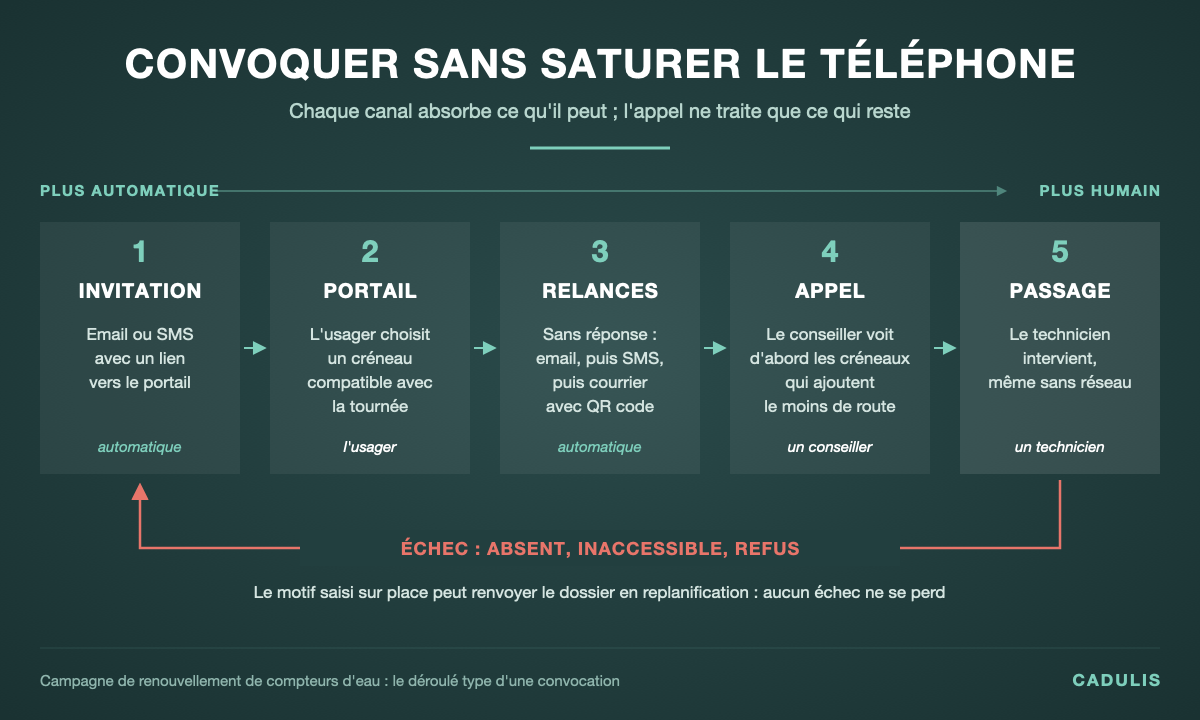
The principle can be summed up in one sentence: each channel absorbs what it can, from the most automated to the most human. The phone is used last, for those who have not responded to anything else.
Announce Early, with a Short Time Slot
A public campaign provides a useful reference. In the Normandy example mentioned above, the user was to receive a letter about fifteen days before the proposed intervention. When their meter was not accessible, the appointment was set for a two-hour window, which could be modified. A short slot indeed requires less waiting from the user than a half-day window.
Let the User Choose, Without Disrupting the Route
In a water meter replacement campaign managed with Cadulis, the invitation is sent by email or SMS, with a link. The user confirms the proposed slot or chooses another, depending on what you allow. However, they only see slots compatible with the route being built: they choose without being able to disrupt it. After a deadline you set, a lock also blocks last-minute changes. The portal can also be integrated directly into the water service’s website.
What proportion of users will book their own appointments? It varies greatly depending on the area and the nature of the campaign, and is measured on your fleet. We presented this process in our article where your customers book appointments directly on technicians’ schedules.
Follow Up in Stages, Up to a Letter
If there’s no response, follow-up can escalate at each stage: an email, then an SMS, then a paper letter with a QR code leading to the portal. These steps are configured according to your rules. The letter especially reaches users who read neither their emails nor their SMS; we also explain how to automate these mailings without touching an envelope.
Reserve Calls for Difficult Cases
There remain users who have not responded to anything. Your advisors call them with the scheduling assistant in front of them: it ranks available slots according to the detour they add, and those that fit into a neighboring route come first. The appointment is thus scheduled during the call, and the call center saves its time for the most resistant cases.
On D-Day: When the User Is Not There
A Failure Reason That Leaves No Case Lost
Absent, inaccessible meter, refusal: the technician selects the reason on their mobile, and the form opens the corresponding fields. This reason can then automatically trigger the case to be sent back to the batch for rescheduling. No failure is left sleeping in a notebook or spreadsheet waiting to be re-entered.
Proving the Technician Showed Up
Sooner or later, a user claims that no one came. The answer lies in what the technician recorded on site: GPS coordinates at the time of validation, and a photo of the closed door with the apartment or mailbox number. You can even make these fields mandatory for one technician and not for another.
Working Without Network in Basements and Shafts
Meters are often hidden where there’s no signal: basements, cellars, technical shafts. Yet the technician’s interventions are loaded onto their mobile. They fill out their report without a network, photos included, and the entry is sent once the signal returns.
After Water Meter Replacement: What Prevents Disputes
Before the Water Mediator, disputes almost always concern the bill. According to the INC, which presents the 2025 report of the Water Mediator, 92% of admissible referrals involved bill disputes: identified leaks (29%), unexplained overconsumption (29%), and adjustments (23%). The Mediator also asks services to ensure that the meter is located in an easily accessible place during its installation, replacement, or relocation.
Renewal is precisely the opportunity to address this point. A few best practices can help:
- take advantage of the removal to move the meter to an accessible location, when possible;
- photograph the reading of the old meter at the time of removal, then that of the new one;
- link these elements to the intervention, so they can be retrieved if the next bill is disputed.
Each modification of an intervention remains available for consultation for one year, with its value before and after. The report follows the service workflow, and the data is sent back to its information system. As for the progress of the campaign, your decision-making dashboards can be displayed in Cadulis to monitor it sector by sector, without waiting until the end of the month. To learn more, see how Cadulis simplifies the creation of complete and accurate activity reports.
What a campaign management software does not replace
Cadulis has its limits. It organizes appointments, routes, and technician visits. Water billing and remote meter reading, however, are handled by the water service’s business tools; for this, Cadulis provides open and documented interfaces, in both directions.
Moreover, a campaign where almost all meters are accessible mainly requires efficient routing. Scheduling appointments becomes useful when a large portion of the meters are located at the user’s premises.
The cost of a campaign depends on revisits
Changing a meter remains the simple part; finding the user at home on the scheduled day requires much more organization. And every case that slips through sorting, follow-up, or rescheduling will sooner or later result in a revisit.
Remote meter reading will be the subject of an upcoming article, as its timeline is among the least understood in the sector. In the meantime, check out our technological innovations for efficient meter readings.
Are you preparing a water meter renewal campaign? Send us the volume and area concerned: we will show you pre-planning on your own sectors, with no integration or commitment required.