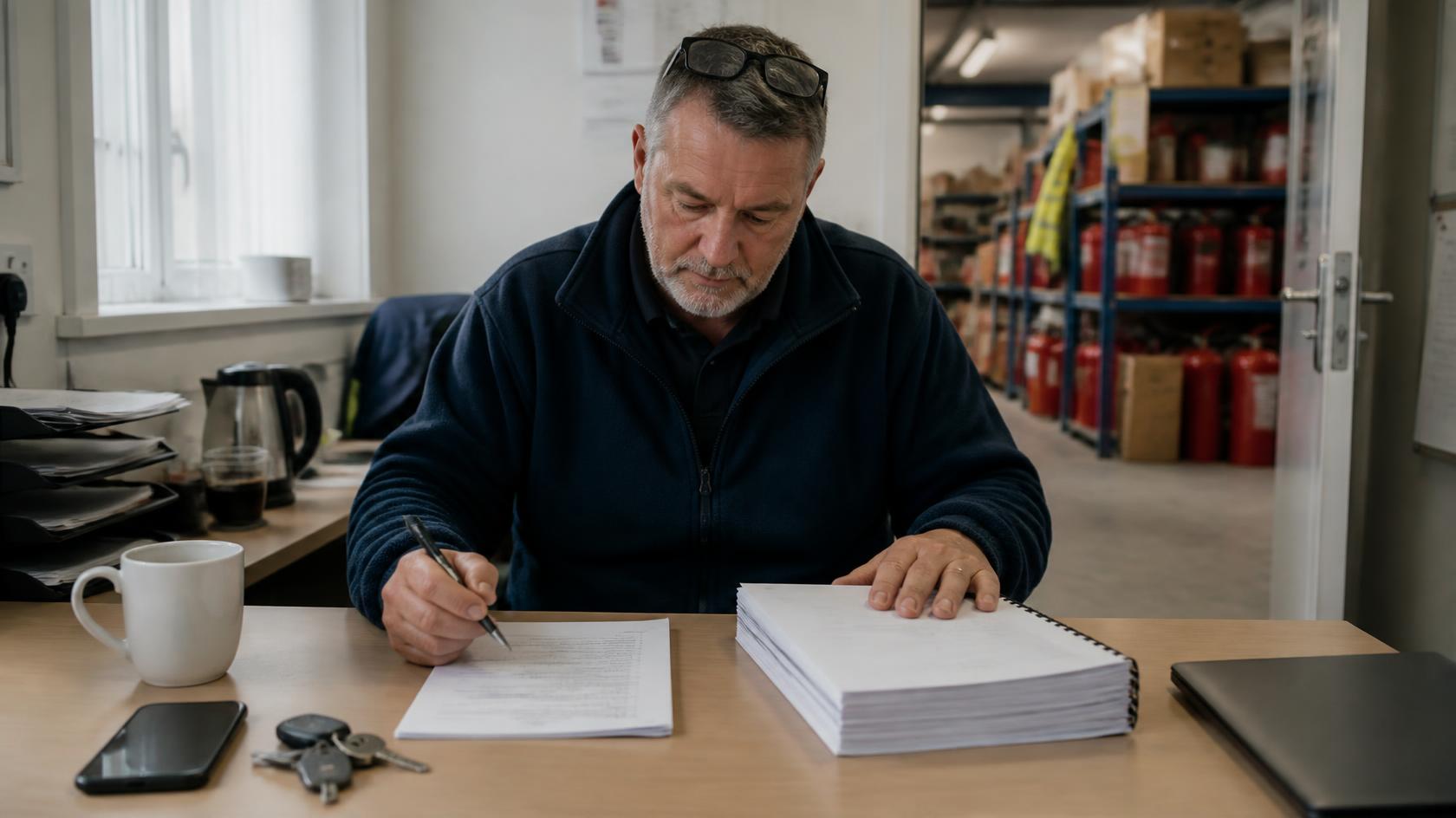
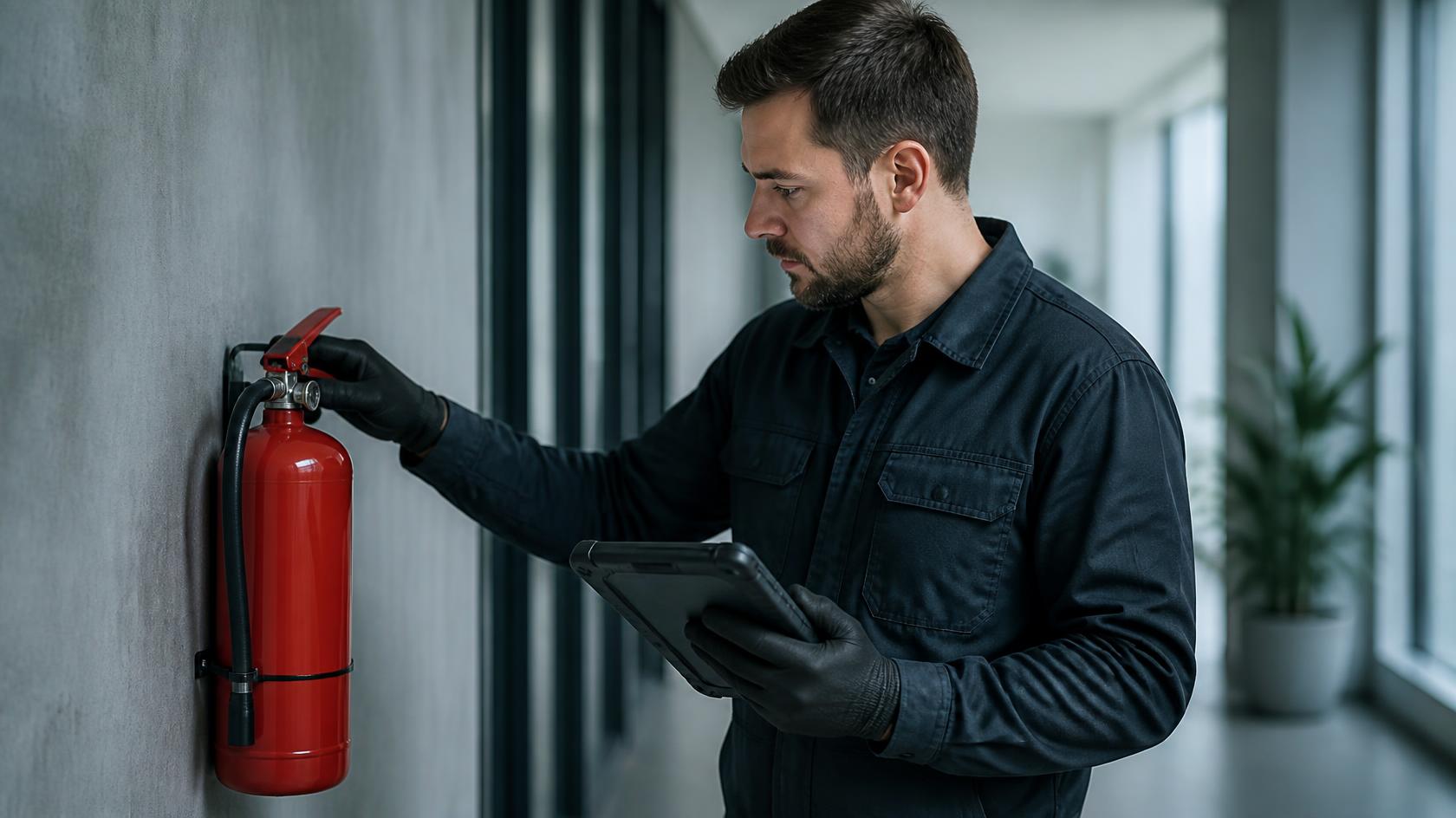
An inspector arrives at a facility where you have been working for six years. He doesn't ask if the fire extinguishers have been checked. He asks to see proof. This is the decisive moment. The traceability of fire safety inspections is not measured by the work accomplished, but by what you can produce, that day, in just a few minutes.
The distinction may seem unfair. Yet it is at the very heart of the profession. Your technicians may have done impeccable work for six years: without usable records, the facility is non-compliant, and so are you.
Good news: the regulations state precisely what evidence is expected. Less good news: they don’t say quite what you read everywhere else.
What the regulations actually require (and what they do not require)
Let’s start with a clarification, because it’s widespread and it’s false.
No, the Labor Code does not require annual fire extinguisher inspections
It is often claimed that Article R4227-29 of the Labor Code establishes the obligation for annual inspections. Let’s look at the text. It says:
“First aid against fire is ensured by a sufficient number of fire extinguishers, maintained in good working order.”
Further details are given about the number of devices: at least one portable water spray extinguisher of at least 6 liters for every 200 m² of floor space, at least one device per level, and appropriate means when premises present particular risks.
Sufficient number, good working order. Not a word about periodicity. No mention of an annual inspection, nor of any schedule.
This is not a legal technicality. When a client asks you on what basis you invoice an annual visit, citing the wrong regulation weakens your position. The obligation does exist — it’s just found elsewhere.
The annual obligation comes from the fire safety regulations for public buildings
For public-access buildings, it is Article MS 38 of the order of June 25, 1980 that sets the requirement, and it does so in remarkably precise terms:
“A fire extinguisher must undergo an annual inspection and a revision every ten years by a competent person or organization. It must be marked with a clearly identifiable label affixed by the person or organization that performed the inspection. The years and months of the inspections must appear on the label. A floor plan showing the location of extinguishers and a record of inspections must be entered in the safety register.”
Read the second half again. The regulation does not just require a technical action. It requires a documentary chain: a dated label on the device, a floor plan, a record in the safety register. Three separate pieces of evidence, in three different places.

Article MS 73 completes the system for other equipment. During operation, fixed and mobile devices and installations must be inspected at least once a year. And for category A and B fire safety systems, as well as for automatic extinguishing systems such as sprinklers, a three-year inspection by an approved person or organization is required in addition to the annual inspection.
Note the shift in terminology between the two articles: “competent” for the annual inspection of extinguishers, “approved” for the three-year inspection of category A and B fire safety systems. These are two different requirements, and confusion comes at a cost during an inspection.
The safety register: a key document
On the operator’s side, the Building and Housing Code requires the maintenance of a safety register, which records, among other things, the dates of various checks and inspections, as well as any observations arising from them. This register has recently been updated by regulation, expanding its content.
You are not its keeper: the register belongs to the operator. But you are the one who supplies it. And it is this document, not your invoicing software, that will be opened on the day of the inspection.
The three proofs you will be asked for
Let’s make this concrete. After an intervention, three elements must exist.
The label on the device. The person who inspects the device affixes the label, with the year and month. This is the most immediate proof: it can be read without opening a binder, and an inspector often looks at it first.
The inspection record and the floor plan, entered in the safety register. These are what turn a series of technical actions into a legally binding history. A fleet of eighty extinguishers spread over six floors without a floor plan is a fleet that no one can audit.
The intervention report. What was checked, by whom, when, with what observations and what follow-up actions. This is your document — the one that protects you if liability is questioned later.
Three proofs. Each produced at a different time, and this is precisely where the system breaks down.
Why proof gets lost along the way
No maintenance company decides to poorly document its interventions. The traceability of fire safety inspections never deteriorates through negligence: it deteriorates through the accumulation of small frictions.
The technician fills out a paper logbook in the technical room. Back at the depot, he leaves the logbook on the desk. Someone will re-enter the data, someday, when there’s time. That is, Friday afternoon, running late on something else, without the context of the intervention.
Meanwhile, he took three photos of a corroded extinguisher. They’re on his phone. That’s where they’ll stay.
The technical room was on the second basement level, with no network. The app, if there is one, couldn’t send anything. The technician jotted notes on a corner of a form, thinking he’d fill it in later.
And then there's the classic case: that technician who knew the site inside out, who knew where the fire extinguisher forgotten behind the pantry door was, and who left the company in April. His knowledge was recorded nowhere.
None of these situations is professional misconduct. But put together, they produce exactly the same result as a mistake: evidence that can't be found the day it's needed.
Build the evidence in the field, not at the office
The principle that settles the issue can be summed up in one sentence: the evidence must be created at the time of the intervention, not reconstructed afterwards. Any delay has a cost. Information is lost, distorted, or the work has to be redone.
In practice, this requires some specific capabilities.
What the tool must be able to do
Forms tailored to each type of equipment. A fire extinguisher, a fire hose reel, a fire door, and an emergency lighting unit are not checked with the same checklist. A generic form forces the technician to interpret, and therefore to enter data haphazardly. A form for each equipment family produces comparable data from one visit to the next—and a readable report.
Timestamped and geolocated photos. The corroded extinguisher is not just a memory: it's a dated, located piece of evidence added to the file. In case of a dispute, "we reported the problem" doesn't carry much weight. A timestamped photo does.
Offline functionality. This job is done in basements, boiler rooms, covered parking lots, and technical rooms where there is no network. An app that requires a connection to record an entry won't help you. Not where you work. The technician enters data offline, and the tool syncs it later.
A report that sends itself automatically. As soon as the intervention is finished, with no re-entry. This is the document the operator will attach to their safety log, and you have no interest in making them wait three weeks.
History, searchable by site and by equipment. To answer in thirty seconds the question "when was the last time you were at this building, and what did you record?".
This is exactly the role of field service management software: automate report generation so that the record is created automatically, while the technician does their job. We explain elsewhere how these reports are actually built.
Field service management or asset management?
One point deserves clarification, as it often comes up in this sector: a field service management tool is not an asset management software. The two approaches coexist, they answer different questions, and the choice depends greatly on your size and organization. We covered this distinction in our comparison between CMMS and field service software, and we will return to it.
What changes on the day of the inspection
An organization whose fire safety traceability is built in the field can answer in a few minutes three questions that would otherwise take a whole day.
Which equipment did you check on this site, and when? What issues did your technicians find, and what did you do about them? Who intervened, and what does their report say?
The most obvious benefit is regulatory. But it's not the only one.
Next comes the business argument. Your client receives their report the same evening, photos included. Why would they put their contract out to bid the following year? The quality of the record builds loyalty, and in a business of recurring contracts, that matters.
Then there's the legal aspect. In case of an incident, the question won't be whether you intervened. It will be what you observed, what you reported, and to whom. An empty file leaves you defenseless. A dated report that notifies the operator of the issue changes everything.
In summary
The fire safety maintenance business is not just a technical job. It's a job about evidence.
The regulations are explicit on this point: dated label on the device, site plan, record entered in the safety log. Three records, produced at three different times, that no Friday afternoon re-entry will ever reconstruct correctly.
The only reliable way to meet this requirement without spending your evenings on it is for the record to be created during the intervention—not afterwards.
Cadulis is a French field service management software: scheduling, mobile app with offline mode, custom forms, timestamped photos, and automatic reports. No commitment, with 200 free credits to get started. Discover how Cadulis can support your inspection rounds.