
Your activity is known twelve months in advance. Every contracted site, every piece of equipment, every deadline: everything is already listed somewhere. And yet, fire maintenance scheduling has you spending the year chasing dates.
This paradox is the daily reality for companies in the sector. It is never due to the unexpected — it is due to accumulation.
An activity that nothing makes unpredictable
A repair technician doesn’t know what they’ll be doing next Tuesday. You do.
Your annual visits result from signed contracts, on inventoried sites, at known dates. Article MS 38 of the safety regulations requires annual inspection of fire extinguishers. Article MS 73 extends the obligation to other devices, with an additional three-year inspection by an accredited organization for category A and B fire safety systems. In fire maintenance scheduling, none of this comes as a surprise.
Which leads to an unpleasant consequence: a missed deadline is never an accident. It reveals an organizational failure, and it is visible.
Why fire maintenance scheduling overflows in waves
If everything is predictable, why do some months overflow while others are slow?
The “signing season” effect. Contracts signed at the same time come due at the same time. A successful sales campaign in spring 2023 creates, every spring, a spike in visits. Yesterday’s success becomes today’s overload.
Inherited portfolios. Acquiring a portfolio, taking over clients from a retiring competitor: you inherit a set of deadlines set to someone else’s calendar. No one has spread them out, so they arrive all at once.
A team that doesn’t change. Your technicians are the same in March and in August. The workload, however, can vary threefold. And since mandatory visits are non-negotiable, slow months never really compensate for saturated ones.
The only move you have: anticipation
This is the scheduling lever that few fire maintenance companies truly exploit.
Faced with a deadline, there are two theoretical directions: delay, or anticipate. In practice, only one is usable.
Delaying exposes you. If an inspection occurs between the scheduled date and your visit, your client is in default. And you are the one they will call.
Anticipating costs you nothing. No client has ever complained about a provider checking a fire extinguisher too early. A visit brought forward by three weeks is still a compliant visit, and the client receives it just like any other.
This asymmetry is a lever for profitability, provided you treat it as such.
What anticipation concretely allows
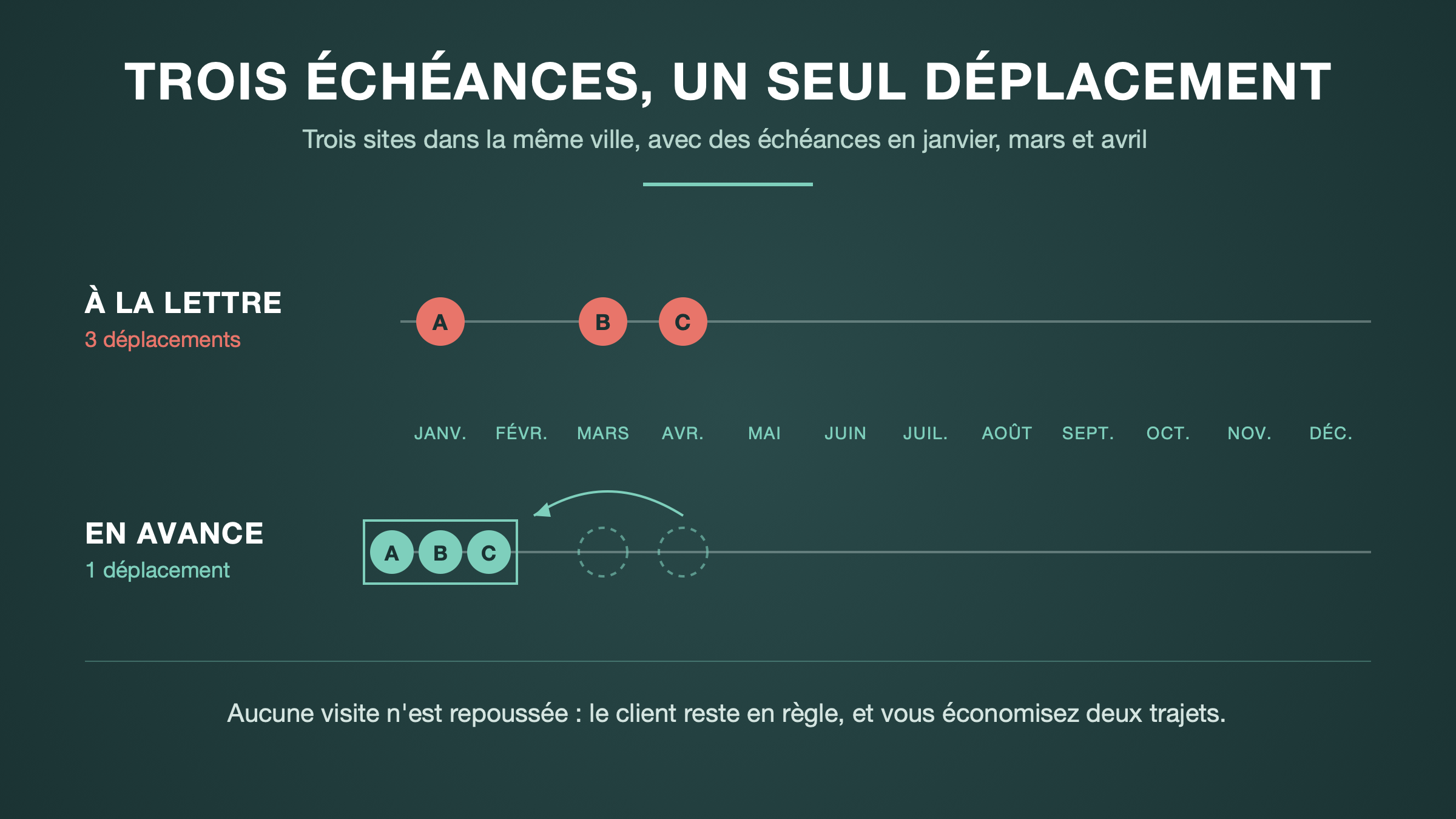
Let’s take three sites in the same city, with deadlines in January, March, and April. Treated to the letter, they require three trips. Grouped in January, they require only one.
You’ve saved two trips without taking any risk, since none of the three visits was postponed.
Apply this reasoning to a portfolio spread across several regions, and your fire maintenance scheduling changes scale. The gain is then counted in technician days per year.
What to watch out for
One point deserves your attention: if you bring a visit forward, do you also bring forward the reference date for the following year?
Depending on your answer, your calendar will slowly drift or remain stable. A visit brought forward every year eventually creates a significant shift after a few cycles. Set the rule once and stick to it — the important thing is that this reference date is a decision, not an accident.
When multiple cycles overlap at the same site
A building with equipment almost never has just one deadline.
Fire extinguishers require an annual inspection and a revision every ten years. Category A and B fire safety systems, such as automatic sprinkler systems, add a three-year inspection performed by an accredited person or organization. So you are tracking several parallel clocks, each running at a different speed.
They also do not involve the same field workers. The regulations distinguish the competent person, sufficient for the annual extinguisher inspection, and the accredited organization, required for the three-year fire safety system inspection. Two similar terms, two different requirements.
This leads to two very concrete difficulties.
The first is knowing who is intervening. A three-year deadline that you are not authorized to fulfill must appear early enough to organize subcontracting — not the week it comes due.
The second is to take advantage of overlaps. Every third year, the annual and the three-year inspections coincide at the same site. Scheduling them in the same week saves a trip and gives the client the impression of an organized provider. At renewal time, this detail matters.
A portfolio tracked equipment by equipment, each with its own cycle, makes these overlaps visible in advance in your fire maintenance scheduling. A list of sites with only one annual date never shows them.
The real cost of a missed deadline
A gap in fire maintenance scheduling seems theoretical until it actually happens.
Your client is in default. During a commission visit or inspection, the lack of an up-to-date check is immediately apparent — the dated label on the device and the entry in the safety register are the first things examined. We detail these proof obligations in our article on fire inspection traceability.
Your liability may be questioned. In the event of an incident, the question will not be whether you had a contract, but when you last visited.
And you often lose the contract. In a business that relies on recurrence, a client who had to chase you for their annual visit is much more likely to listen to the competitor who calls them in November.
The most frustrating part is the relationship between cause and effect. No one loses a maintenance contract over the quality of a fire extinguisher inspection — everyone does that part correctly. You lose it over a date forgotten in a spreadsheet, that is, over something unrelated to the actual job.
Keeping fire maintenance scheduling on track without thinking about it
A spreadsheet is enough for twenty clients. It becomes dangerous at two hundred, because it requires someone to keep an eye on it.
Deadlines that reschedule themselves. When an intervention is closed, the next one is automatically created at the desired date. The portfolio maintains itself, without anyone having to manually update anything.
A useful alert, therefore anticipated. Being notified on the due date is pointless: the route is already finalized. A notification two months in advance, however, arrives just as the schedule is still being built — that is, when you can still group visits together.
A proposed, not searched, geographical grouping. When the tool knows the locations and dates, it can suggest which visits to bring forward to make a route denser. The research work disappears, and the decision is yours.
A three-state view of your asset base. What’s done, what’s approaching, what’s overdue. This is the view you open on Monday morning, and it answers in thirty seconds the question everyone asks: are we up to date?
It also makes a technician’s departure painless. Their sites, due dates, and notes remain accessible, instead of leaving with them.
We covered these mechanisms from a broader perspective in our article on optimizing maintenance interventions and in the one dedicated to real-time scheduling as a performance lever for your field teams.
Renewal, the blind spot in fire maintenance scheduling
One last date deserves to be tracked, and almost no one does.
The visit deadline is not the same as the contract deadline. The first recurs every year, the second ends on a specific day — often without anyone noticing until the termination notice arrives.
A provider who calls their client two months before the contract deadline, with the full history of interventions at hand, is not in the same position as one who only discovers the termination after the fact.
In summary
Fire maintenance scheduling is based on three simple ideas.
Your activity is predictable: a missed deadline is a matter of organization, not bad luck. Being ahead of schedule is your only real lever, and it costs nothing — unlike being late, which puts your client at risk. Finally, a portfolio of a few hundred contracts becomes unmanageable as soon as it relies on someone remembering to check a spreadsheet.
The rest is just a matter of having the right tool.
Cadulis is a French field service management software: route planning and optimization, recurring deadlines, mobile app with offline mode, and automatic reports. No commitment, with 200 free interventions to get started. Discover how Cadulis tracks your inspection routes.