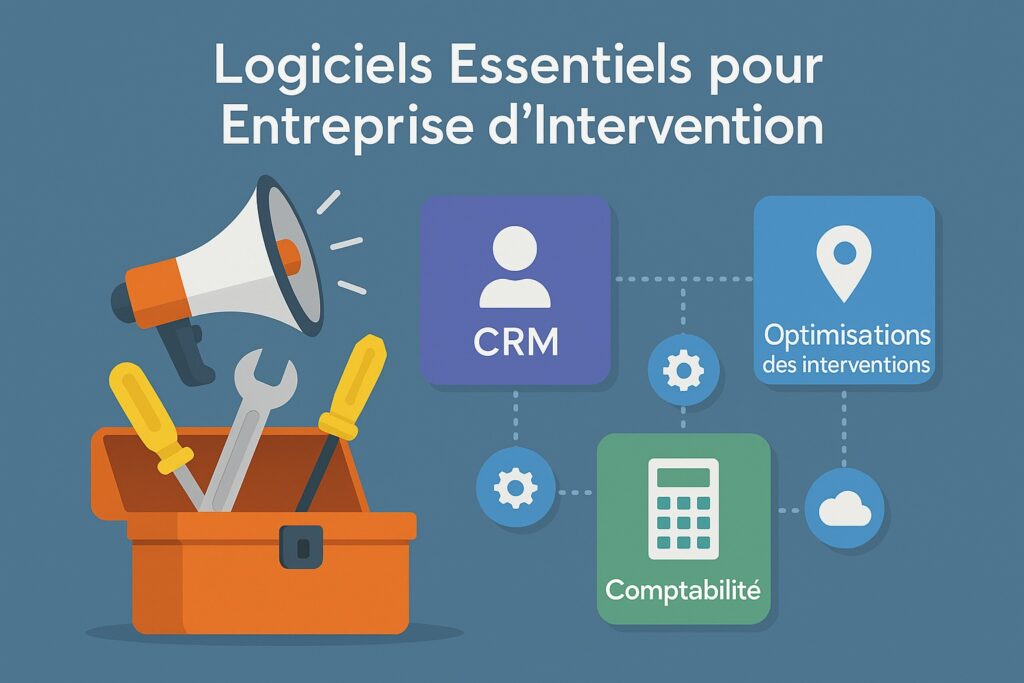

Essential Software for Field Service Professionals: When Technology Becomes Your Best Worker
Running a field service business is no walk in the park. Between prospecting, route planning, quotes, invoices, and accounting, days quickly turn into an administrative marathon. Fortunately, essential software for field service professionals exists to bring some order to this cheerful chaos.
When the professional has to do everything… except sleep
A field service professional is often an expert in their trade: an electrician taming unruly wires, a plumber rescuing bathrooms in distress, a personal services specialist who knows their clients inside out. But when it comes to organizing routes or handling paperwork, the magic fades.
Let’s be honest: being good at your trade doesn’t mean you enjoy administration. And yet, without the right tools, the business stagnates, the manager burns out, and profitability takes a hit.
Three essential building blocks to keep the business standing
To run smoothly, a field service company needs three software pillars:
- A CRM (Customer Relationship Management) to manage client relationships, from first contact to loyalty.
- Field service optimization software, the true logistical brain.
- Accounting software, so that month-end doesn’t rhyme with headaches.
And the secret to performance? These three building blocks must be connected via API, so that data flows like water through well-laid pipes—without leaks or waste.
The CRM: managing clients better without losing track
The CRM is the company’s memory bank. This is where quotes are created, prospects are tracked, and client relationships are cultivated.
But beware: not all CRMs are created equal. Some, like Hubspot, are powerful… but also dauntingly complex for small businesses.
Field professionals often prefer more accessible tools, such as Sellsy, which combines sales management, client tracking, and invoicing in a clear interface.
The ideal CRM should:
- Provide a global view of each client, from the first request to the last invoice,
- Offer clear documentation and support in English,
- Include connectors or APIs to communicate with other business tools.
Because an isolated CRM is like a worker without a toolbox: motivated, but limited.
Field service optimization software: the GPS of profitability
This is often where everything comes together.
Good field service optimization software is more than just an enhanced calendar: it’s a true logistics assistant. It takes into account client geolocation, field worker skills, site opening hours, and even lunch breaks (yes, really).
The goal? Reduce unnecessary mileage.
Every trip saved means a tank of fuel and an hour of work gained. Over a month, the difference is clear: less fatigue, more jobs completed, and higher client satisfaction.
Good optimization software should allow you to:
- Automatically calculate distances between jobs,
- Manage time constraints,
- Update schedules in real time,
- Easily communicate assignments to field workers.
Tools like Cadulis perfectly embody this philosophy: clear visibility on schedules, optimized routes, and smooth information flow between the field and the office.
Accounting: less paperwork, more accuracy
Another essential link in the chain: accounting.
Here again, everything relies on automation. Every minute spent re-entering invoices is a minute stolen from your core business.
Good accounting software for field professionals should:
- Automatically generate and send invoices as soon as the job is validated,
- Prevent missed invoices,
- Track payments for smart follow-ups,
- Be compatible with major CRMs and field management tools.
This is where software integration becomes a blessing.
When a technician closes a job in their app, the invoice is sent automatically, the client receives it instantly, and the accountant can sleep soundly.
Why APIs are a game changer
APIs (Application Programming Interface) are often seen as technical jargon, but in reality, they are the glue of modern efficiency.
They allow software to communicate without humans having to re-enter anything.
- Fewer errors,
- Less double entry,
- Less wasted time,
- And above all… greater profitability.
A good API is like a good apprentice: it works without needing supervision.
Concrete example: the virtuous loop
Let’s look at a real case.
A field professional validates a job in their scheduling software. Automatically, an invoice is generated, sent to the client, and integrated into the accounting software. The payment is tracked, and the CRM updates the client’s status.
No manual entry, no oversight, and above all, no wasted time.
The manager can then focus on what they do best: their trade.
Cadulis: an intelligent link in this digital chain
At the heart of this software ecosystem, Cadulis stands out as a natural ally.
Designed for field service businesses, it enables:
- Intuitive and optimized scheduling,
- Centralization of information,
- Configurable forms to collect field data,
- And seamless integration with other tools thanks to its APIs.
Thanks to this interconnection, field professionals save time, reduce travel, and maintain a clear view of their activities.
And let’s be honest, it feels great not to spend your evenings juggling Excel, notebooks, and paper invoices.
Conclusion: the winning trio of performance
CRM, optimization, and accounting: three software solutions, three functions, but a single ambition: freeing field service professionals from invisible workload.
By choosing them wisely — and especially by connecting them intelligently — a small business can compete with the largest, while remaining agile.
What if technology finally became the best jobsite companion?
In summary
- CRM → structures and strengthens customer relationships.
- Optimization software → saves time and reduces costs.
- Accounting software → automates invoicing and payments.
- API → ensures smooth communication between all these tools.
Modern field professionals no longer work alone: they surround themselves with the right software. And with a bit of humor… we could say these tools are the new digital apprentices for field service companies.